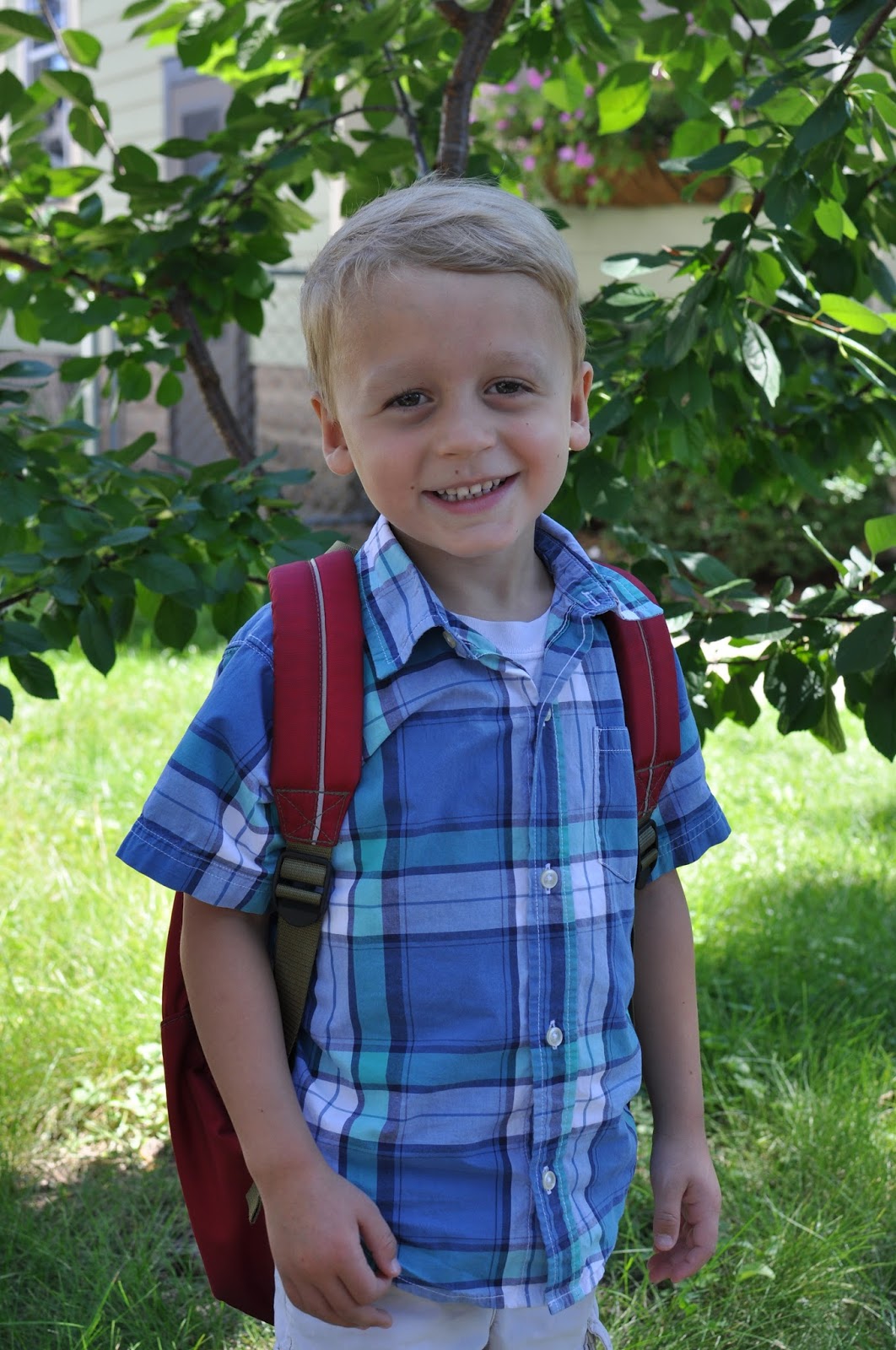
My "twins" started Pre-K today. Don't they look so ready and full of promise?
We opted to send Kiera and Soren to Pre-K at the school down the street from our house to not only take advantage of free tuition, but also the routine of going five afternoons a week and extra support and services for Kiera. There are 20 students in the class and four teachers, one of whom is an early childhood special education teacher. A speech therapist working exclusively at the school will provide Kiera's speech services in the classroom.
I came home at lunchtime so I could walk with them to their first day of school. Soren told me he was both nervous and excited.
The students and their parents gathered outside, but when the teachers asked the kids to line up, Soren started to cry. Just as it is for his older brother, new places and new people are tough for Soren. As I comforted him, I was surprised at how teary-eyed I became, even though I knew that with time, Soren is going to love school. He settled down, and when the line of children started to file into the building, he sought out comfort from his sister by grasping her hand and walked semi-confidently side-by-side with her into the building.
Despite a couple of emotional moments during the rest of his afternoon at preschool, Soren gave the experience a thumbs up. He reported that he probably won't cry tomorrow, or maybe just a little.
Kiera was also excited to start Pre-K and if she was nervous, she didn't show it. She generally goes with the flow in new situations. Her teacher reported that she didn't communicate more than with some nodding of her head, which I wasn't surprised by given it's a new environment, but she was otherwise engaged in the activities and happy to be there. When I asked her what she did at school, the most I got out of her was "played".
From these quiet and nervous beginnings, I can't wait to see what this year as in store for Kiera and Soren.
Kiera, Matteo, Oliver and Soren
Showing posts with label Kiera Update. Show all posts
Thursday, September 8, 2016
Pre-K
Labels:
Education,
Kiera,
Kiera Update,
Linwood Monroe Arts Plus,
Pre-K,
School,
Soren,
Soren update
Sunday, April 17, 2016
Kiera is Off and Pedaling
The first time Kiera hopped on a tricycle, she road it around like she'd always known how to pedal, even though we knew that was far from the case. So it surprised me that she could not figure out how to ride a bike with training wheels. She would pedal half a revolution and then push the pedals backwards and engage the brake. Kiera is persistent and would want to keep riding, so I'd help push her feet forward and every single time, she'd pedal half a revolution forward and press her pedals backward. Every single time. Locked into place, our stubborn Kiera would continue to slam her feet backwards on the pedals until she'd start crying in frustration. I was out of ideas for how to teach her to pedal forward and her perpetual frustration wasn't productive either, so I ended up no longer letting her ride the bike with the training wheels and made her ride the balance bike.
Then one day our seven-year-old neighborhood offered to teach Kiera. She patiently pushed on Kiera's legs to force her to pedal and then pushed the bike by its handlebars so Kiera could learn that that pedals work when you push forward. After only a few minutes and a couple trips up and down the sidewalk, Kiera was pedaling on her own. I couldn't believe it! And Kiera was so proud of herself too. She rode up and down the block and each time she passed by me, she turned and flashed me a huge smile. If she hadn't know she's not allowed to ride past the house on the corner to the south of us and Halifax's old house (the 110-pound Bernese Mountain Dog) to the north of us, I think she may just have pedaled off into the sunset.
Oliver, who had recently relearned to ride a bike without training wheels, was not so impressed. He wasn't sure what the big deal was or why I cheered encouragement to Kiera every time she pedaled past me.
I refrained from reminding Oliver that even though he now knows how to walk or eat with utensils, we cheered for him when he took his first steps and when he managed to connect his spoon with his mouth instead of flinging his food into his face. Rooting on our children when they experience a success, however small, is what parents do. And for young children, it's developmentally appropriate. When we smile and talk baby talk back at a babbling baby, they are motivated to keep "talking" until they eventually say something that means something. And then we cheer some more.
We don't know if Kiera had anyone cheering her on when she said her first word or took her first steps, or if she felt like anyone cared. But we do know Kiera is a little girl who needs lots of encouragement. Almost daily we witness Kiera experience a situation similar to not being able to pedal not the bike and not being able to ask for help and then getting frustrated to the point of tears. To watch her work to figure something out was such a proud mom moment. We don't know much about her past, but as she rode by me and made sure I was watching her and that I was excited for her, she knows she has parents who cheer for her unconditionally.
Then one day our seven-year-old neighborhood offered to teach Kiera. She patiently pushed on Kiera's legs to force her to pedal and then pushed the bike by its handlebars so Kiera could learn that that pedals work when you push forward. After only a few minutes and a couple trips up and down the sidewalk, Kiera was pedaling on her own. I couldn't believe it! And Kiera was so proud of herself too. She rode up and down the block and each time she passed by me, she turned and flashed me a huge smile. If she hadn't know she's not allowed to ride past the house on the corner to the south of us and Halifax's old house (the 110-pound Bernese Mountain Dog) to the north of us, I think she may just have pedaled off into the sunset.
Oliver, who had recently relearned to ride a bike without training wheels, was not so impressed. He wasn't sure what the big deal was or why I cheered encouragement to Kiera every time she pedaled past me.
I refrained from reminding Oliver that even though he now knows how to walk or eat with utensils, we cheered for him when he took his first steps and when he managed to connect his spoon with his mouth instead of flinging his food into his face. Rooting on our children when they experience a success, however small, is what parents do. And for young children, it's developmentally appropriate. When we smile and talk baby talk back at a babbling baby, they are motivated to keep "talking" until they eventually say something that means something. And then we cheer some more.
We don't know if Kiera had anyone cheering her on when she said her first word or took her first steps, or if she felt like anyone cared. But we do know Kiera is a little girl who needs lots of encouragement. Almost daily we witness Kiera experience a situation similar to not being able to pedal not the bike and not being able to ask for help and then getting frustrated to the point of tears. To watch her work to figure something out was such a proud mom moment. We don't know much about her past, but as she rode by me and made sure I was watching her and that I was excited for her, she knows she has parents who cheer for her unconditionally.
Saturday, March 12, 2016
Happy Birthday Kiera!
With a March birthday, what kind of weather you have on your big day is a huge wild card here in Minnesota. Amazingly, two years in a row Kiera has gotten sunny and unseasonably warm weather on her birthday. And this year was even more amazing than last with temperatures that rose to the high 60s.
Grandma Nan and Grandpa Dan hosted Kiera's party this year and because her birthday was on a Saturday, we spent the whole afternoon there. We started with lunch, had some cake, played outside, opened some presents and then played some more. It was a glorious way to celebrate our beautiful little girl.
There are times when I worry Kiera could feel left out having a March birthday when her brothers and dad have fall birthdays, but if there's any advantage, it's that she gets tons of presents and none that she's sharing with a sibling. Her gifts really celebrated her interests and her style. She got a book, hair bows, clothes, Legos and a giant dollhouse with Caucasian and Asian dolls.
Only recently has it struck me how much Kiera has grown in this past year. She still looked much like a toddler last year and now she looks so grown up. I look at her picture and think that if I blink she'll be asking for the car keys or packing to move out on her own.
Our Kiera has changed a lot. She's a lot more confident and all us adults in her life work hard to make sure she feels safe and secure enough to let her personality shine. One outward sign that she's more confident is that she smiles for photographs. Until just a couple of months ago, the most we could usually get out of her was a smirk or a half smile. Now she will happily smile when she sees me with the camera, and often without me even asking.
She's also making some strides with talking. Although she's still incredibly difficult to understand due to the multiple articulation errors at play, we're thrilled to hear her initiate speech more often. If we ask her what she wants, we might, just might, get a (one-word) answer. A few times she'll even tell us something without us asking first. We clearly have a long, long way to go, but we've all noticed an uptick in her speech and it gives me hope that we're starting to make some progress.
Like most kids, Kiera loves being outside. Her favorite activity at the park is still the swings. She's finally too big for the baby swing, but hasn't learned how to pump yet. She also loves riding her bike. She tools around on her strider bike like she owns the street.
Like her big brother Oliver, Kiera likes to paint and draw. However, you have to keep an eye on her though or she and Matteo will empty the entire art cabinet in our dining room onto the floor. And let's just say that she hasn't developed an interest in cleaning up after herself.
She's also following in her brothers' footsteps with an interest in Legos and loves sitting at the Lego table Chris built for the kids and stacking Legos on top of each other. Oliver had wanted to help Kiera so badly to put together the set she had gotten for her birthday, but we were afraid he would take over and she would end up in tears. He made us so proud with how so very sweet and patient he was with her. The only time he showed frustration was when they finished and Kiera prompted destroyed the whole creation they had built. Sigh, she is only four and hasn't learned to appreciate the final product.
Despite her destructiveness with Legos, Kiera shows a maturity beyond her four years of age. I can bring her so many places that most people cringe at the thought of bringing a four-year-old. She doesn't whine or complain about going to Target or accompanying me on other errands. She sticks by my side and mostly entertains herself without getting bored.
Kiera's best buddy at the moment is her brother Matteo. They share a room, go to preschool together and generally spend a lot of time with each other since they're on the same page developmentally. They spend so much time together that their speech pathologist thinks they've developed their own language, or "twin speak". It really does sound like they speak gibberish to each other.
Grandma Nan and Grandpa Dan hosted Kiera's party this year and because her birthday was on a Saturday, we spent the whole afternoon there. We started with lunch, had some cake, played outside, opened some presents and then played some more. It was a glorious way to celebrate our beautiful little girl.
| The birthday girl is four! |
| Kiera and Celina |
There are times when I worry Kiera could feel left out having a March birthday when her brothers and dad have fall birthdays, but if there's any advantage, it's that she gets tons of presents and none that she's sharing with a sibling. Her gifts really celebrated her interests and her style. She got a book, hair bows, clothes, Legos and a giant dollhouse with Caucasian and Asian dolls.
Only recently has it struck me how much Kiera has grown in this past year. She still looked much like a toddler last year and now she looks so grown up. I look at her picture and think that if I blink she'll be asking for the car keys or packing to move out on her own.
![]() |
| Two pictures taken exactly a year apart: Kiera on her third birthday (left) and her fourth birthday (right) |
She's also making some strides with talking. Although she's still incredibly difficult to understand due to the multiple articulation errors at play, we're thrilled to hear her initiate speech more often. If we ask her what she wants, we might, just might, get a (one-word) answer. A few times she'll even tell us something without us asking first. We clearly have a long, long way to go, but we've all noticed an uptick in her speech and it gives me hope that we're starting to make some progress.
Like most kids, Kiera loves being outside. Her favorite activity at the park is still the swings. She's finally too big for the baby swing, but hasn't learned how to pump yet. She also loves riding her bike. She tools around on her strider bike like she owns the street.
Like her big brother Oliver, Kiera likes to paint and draw. However, you have to keep an eye on her though or she and Matteo will empty the entire art cabinet in our dining room onto the floor. And let's just say that she hasn't developed an interest in cleaning up after herself.
She's also following in her brothers' footsteps with an interest in Legos and loves sitting at the Lego table Chris built for the kids and stacking Legos on top of each other. Oliver had wanted to help Kiera so badly to put together the set she had gotten for her birthday, but we were afraid he would take over and she would end up in tears. He made us so proud with how so very sweet and patient he was with her. The only time he showed frustration was when they finished and Kiera prompted destroyed the whole creation they had built. Sigh, she is only four and hasn't learned to appreciate the final product.
Despite her destructiveness with Legos, Kiera shows a maturity beyond her four years of age. I can bring her so many places that most people cringe at the thought of bringing a four-year-old. She doesn't whine or complain about going to Target or accompanying me on other errands. She sticks by my side and mostly entertains herself without getting bored.
Kiera's best buddy at the moment is her brother Matteo. They share a room, go to preschool together and generally spend a lot of time with each other since they're on the same page developmentally. They spend so much time together that their speech pathologist thinks they've developed their own language, or "twin speak". It really does sound like they speak gibberish to each other.
Sunday, February 21, 2016
Speech Consultation at the Mayo
When Chris heard I was bringing Kiera to the Mayo Clinic for a speech consultation, he joked with me that I was "bringing out the big guns." I sure was. I was tired of hearing people tell me that Kiera just needs time to adjust and that she's still learning English. She's been home for a year and turns four in March. She starts kindergarten in a year and a half and can't communicate with more than one word, if she initiates speech at all. I'm too impatient for a "wait and see" approach and have grown increasingly frustrated with her lack of progress despite the intensive speech therapy she's undertaken since July.
Our consult at the Mayo Clinic was with Dr. Ruth Stoeckel, an expert in speech and language disorders. This is the speech language pathologist recommended by my Facebook group for parents of children adopted from China who have speech and language delays. When I had no idea what to do next, this group offered their support and ideas.
As expected, it took Kiera some time to warm up, so she wouldn't make a peep as Dr. Stoeckel tried to engage her. She wouldn't even tell the doctor her name. As we know, Kiera responds to movement and once Dr. Stoeckel got her interested in a Nerf gun and was suddenly incredibly LOUD as she chased after the Nerf pellets.
Dr. Stoeckel tested Kiera's receptive language first. For conversational receptive language (tested using questions about the child, like asking how she's doing, what her name is, how many brothers and sisters she has, etc.) Kiera tested in the three-to-four-year-old range. For academic receptive language, (tested by having her answer questions about a picture, such as asking where certain objects are located in a picture or what she sees) she tested on the level of a three-year-old. Academic receptive language is considered harder and it's not surprising when kids score lower. Overall, Dr. Stoeckel has no receptive language concerns and this is in line with what the school district found when they tested her in the early fall.
Dr. Stoeckel's speech evaluation revealed that Kiera can say a lot of words, but with a lot of errors. With the multiple speech issues the doctor pointed out, it now makes sense that Kiera's speech is so unintelligible.
Dr. Stoeckel diagnosed Kiera with having a "speech sound disorder" and "delayed expressive language skills secondary to the speech sound disorder." She didn't identify any obvious language disorder at this time, but said that could change as she gets older and she talks more and they can better diagnose her.
Kiera has motor planning problems, which means it's harder for her to sequence longer words or phrases. This might explain why Kiera really doesn't talk with more than one word at a time and that her few two-word phrases are not more than two or three syllables in total. (For example, she yells, "Do it!" if she wants to do something for herself, like get herself dressed instead of letting me help her.) Or when you ask her to say a word with three or more syllables, she gets lost before she finishes saying the word. If you've noticed, typical of a kid Kiera's age, she "asks" a lot of questions. For Kiera, that means every movement you make prompts her to ask, "Doing?" Saying an entire sentence of "What are you doing?" is too much to sequence. Plus, she's probably figured out that we know what she's asking simply by using the one word.
Motor planning might also explain why she has trouble answering questions, like what she wants for lunch or even her own name. Kiera most likely knows what she wants, but something as easy as saying, "I would like a peanut butter and jelly sandwich" or even, "peanut butter and jelly" is a lot for her brain to sequence and communicate with her mouth to say. While we may never know what other factors play into her inability to answer questions or initiate speech, she could be aware of the errors she makes and be self-conscious, or she could have adapted to her speech limitations and makes do with pointing or not getting what she wants.
I had originally thought could possibly have Childhood Apraxia of Speech (Apraxia), and even the neurologist at the Mayo who reviewed the videos I had taken of Kiera speaking, thought that could be the case, but Dr. Stoeckel, an expert in Apraxia, says she doesn't have it. However, the "motor planing with vowel movement" that Kiera presents is present in all kids with Apraxia. A small number of kids have motor planing issues, but not Apraxia, and Kiera fits in this category. The main clue that Kiera does not have Apraxia is that there is often consistency with her errors and when she has someone guide her through the word, she can often say it correctly by the third try. (That is, if she's in the mood!) Kids with Apraxia will say the same word three different ways and not get it right. There's no pattern to their errors.
Here are two resources that talk more about motor planning. They are specific to Apraxia, but the information is still relevant to Kiera.
Dr. Stoeckel recommended some speech pathologists at Children's Hospital of Minnesota, but unfortunately, we couldn't get Kiera on any of their schedules. Since we haven't been happy with her progress at Gillette's, we'll still give Children's a try with a different speech pathologist. Our first appointment is in mid-March.
Both Kiera and Matteo have been receiving speech services through the school district twice a week. The wonderful part is that these services are free and the speech pathologist comes to our home. Their speech pathologist is familiar with Core Language Therapy and did some extra research to come up with a new game plan for Kiera. Our goal now is to work with Kiera on familiar words that she needs to communicate. We'll work on up to 10 each week. The task is to twice a day have Kiera practice pronouncing each word five times. The idea isn't to quiz Kiera on what the picture is, because she most likely knows that, but to provide an example of how to say the word and then get her to repeat it. Because of her motor planning issues, Kiera might not be able to produce the word correctly on her own without watching and hearing someone say the word, which is why much of our "quizzing" her on names of objects has been mostly fruitless and frustrating for both us and Kiera. The hope is that practice will increase brain "muscle memory" so that words her brain has struggled to communicate to her mouth to speak, or speak correctly, will become second-nature.
Because there's an emotional/psychological component to Kiera not being able to/wanting to speak, the speech pathologist also suggested we create a sticker chart and make a big deal out of Kiera using words to communicate her wants or needs, similar to what we did with Oliver and Soren during toilet-training.
I'm looking forward to a new chapter in Kiera's speech therapy, but I'm also overwhelmed because even under the best of circumstances with a proper diagnosis and skilled speech pathologists providing the correct kind of therapy, we still have a long road ahead of us and a lot work to do.
Our consult at the Mayo Clinic was with Dr. Ruth Stoeckel, an expert in speech and language disorders. This is the speech language pathologist recommended by my Facebook group for parents of children adopted from China who have speech and language delays. When I had no idea what to do next, this group offered their support and ideas.
As expected, it took Kiera some time to warm up, so she wouldn't make a peep as Dr. Stoeckel tried to engage her. She wouldn't even tell the doctor her name. As we know, Kiera responds to movement and once Dr. Stoeckel got her interested in a Nerf gun and was suddenly incredibly LOUD as she chased after the Nerf pellets.
Dr. Stoeckel tested Kiera's receptive language first. For conversational receptive language (tested using questions about the child, like asking how she's doing, what her name is, how many brothers and sisters she has, etc.) Kiera tested in the three-to-four-year-old range. For academic receptive language, (tested by having her answer questions about a picture, such as asking where certain objects are located in a picture or what she sees) she tested on the level of a three-year-old. Academic receptive language is considered harder and it's not surprising when kids score lower. Overall, Dr. Stoeckel has no receptive language concerns and this is in line with what the school district found when they tested her in the early fall.
Dr. Stoeckel's speech evaluation revealed that Kiera can say a lot of words, but with a lot of errors. With the multiple speech issues the doctor pointed out, it now makes sense that Kiera's speech is so unintelligible.
- Final consonant omissions - We're all familiar with how Kiera does not say the final letter in a word. "Hat" is "Haaa."
- Vowel distortions - She might pronounce the word "book bag" like "bay bye". We have a lot of vowel sounds in the English language (16?) and Kiera distorts a fair number of these.
- Fronting - She replaces certain sounds with other sounds, such as saying "tar" instead of "car."
- Cluster reduction - This is where she reduces consonants in a longer word or drops letters to make a word shorter or easier to say, such as saying "boon" instead of "spoon." I was told this is not unusual for this age and stage of English acquisition.
- Glottal stop - not sure how to explain this one...
Dr. Stoeckel diagnosed Kiera with having a "speech sound disorder" and "delayed expressive language skills secondary to the speech sound disorder." She didn't identify any obvious language disorder at this time, but said that could change as she gets older and she talks more and they can better diagnose her.
Kiera has motor planning problems, which means it's harder for her to sequence longer words or phrases. This might explain why Kiera really doesn't talk with more than one word at a time and that her few two-word phrases are not more than two or three syllables in total. (For example, she yells, "Do it!" if she wants to do something for herself, like get herself dressed instead of letting me help her.) Or when you ask her to say a word with three or more syllables, she gets lost before she finishes saying the word. If you've noticed, typical of a kid Kiera's age, she "asks" a lot of questions. For Kiera, that means every movement you make prompts her to ask, "Doing?" Saying an entire sentence of "What are you doing?" is too much to sequence. Plus, she's probably figured out that we know what she's asking simply by using the one word.
Motor planning might also explain why she has trouble answering questions, like what she wants for lunch or even her own name. Kiera most likely knows what she wants, but something as easy as saying, "I would like a peanut butter and jelly sandwich" or even, "peanut butter and jelly" is a lot for her brain to sequence and communicate with her mouth to say. While we may never know what other factors play into her inability to answer questions or initiate speech, she could be aware of the errors she makes and be self-conscious, or she could have adapted to her speech limitations and makes do with pointing or not getting what she wants.
I had originally thought could possibly have Childhood Apraxia of Speech (Apraxia), and even the neurologist at the Mayo who reviewed the videos I had taken of Kiera speaking, thought that could be the case, but Dr. Stoeckel, an expert in Apraxia, says she doesn't have it. However, the "motor planing with vowel movement" that Kiera presents is present in all kids with Apraxia. A small number of kids have motor planing issues, but not Apraxia, and Kiera fits in this category. The main clue that Kiera does not have Apraxia is that there is often consistency with her errors and when she has someone guide her through the word, she can often say it correctly by the third try. (That is, if she's in the mood!) Kids with Apraxia will say the same word three different ways and not get it right. There's no pattern to their errors.
Here are two resources that talk more about motor planning. They are specific to Apraxia, but the information is still relevant to Kiera.
- http://www.apraxia-kids.org/
library/what-is-the- difference-between-speech- motor-planning-programming- and-execution/ - http://www.tayloredmktg.com/
dyspraxia/das.shtml
Dr. Stoeckel recommended some speech pathologists at Children's Hospital of Minnesota, but unfortunately, we couldn't get Kiera on any of their schedules. Since we haven't been happy with her progress at Gillette's, we'll still give Children's a try with a different speech pathologist. Our first appointment is in mid-March.
Both Kiera and Matteo have been receiving speech services through the school district twice a week. The wonderful part is that these services are free and the speech pathologist comes to our home. Their speech pathologist is familiar with Core Language Therapy and did some extra research to come up with a new game plan for Kiera. Our goal now is to work with Kiera on familiar words that she needs to communicate. We'll work on up to 10 each week. The task is to twice a day have Kiera practice pronouncing each word five times. The idea isn't to quiz Kiera on what the picture is, because she most likely knows that, but to provide an example of how to say the word and then get her to repeat it. Because of her motor planning issues, Kiera might not be able to produce the word correctly on her own without watching and hearing someone say the word, which is why much of our "quizzing" her on names of objects has been mostly fruitless and frustrating for both us and Kiera. The hope is that practice will increase brain "muscle memory" so that words her brain has struggled to communicate to her mouth to speak, or speak correctly, will become second-nature.
Because there's an emotional/psychological component to Kiera not being able to/wanting to speak, the speech pathologist also suggested we create a sticker chart and make a big deal out of Kiera using words to communicate her wants or needs, similar to what we did with Oliver and Soren during toilet-training.
I'm looking forward to a new chapter in Kiera's speech therapy, but I'm also overwhelmed because even under the best of circumstances with a proper diagnosis and skilled speech pathologists providing the correct kind of therapy, we still have a long road ahead of us and a lot work to do.
Tuesday, February 2, 2016
One Year Ago Today We Met Kiera
One year ago, it was finally time to meet Kiera. In a crowded and humid
civil affairs office in Guangzhou, the provincial capital of Guangdong,
Kiera surprised us by being one of the first to arrive. Before I
realized what was happening, a quiet, curious little girl stood in front
of me as her nanny urged her to go to Mama. This brave girl indeed
came to me and never looked back. Our hearts were finally complete.
Read about our first day with Kiera.
February 2, 2015 in Guangzhou, Guangdong
One year later home in Minnesota
Read about our first day with Kiera.
February 2, 2015 in Guangzhou, Guangdong
One year later home in Minnesota
Sunday, December 20, 2015
Ice Skating with Kiera
Look who I got out on skates.
I never would have thought the child of mine who was born in a semi-tropical region of the world would be the first of my children to try ice skating. The others showed scant interest at best. But Kiera? I told her she'd have to wear her snow pants if she wanted to go ice skating with me and when I came downstairs, she was nearly dressed and ready to go.
Kiera was so excited when we headed out the door, which is funny, because she had no idea what ice skating was. She looked at me with slight discomfort as I tried to cram her feet into the skates and then was in for quite a shock when I plunked her down on the rink with two metal blades strapped to her feet.
I hunched over and hooked my arms under hers and helped her glide her feet across the ice. She didn't seem to understand that she needed to put weight on her feet and instead leaned back into my arms. I was exhausted after one lap around the rink. A friend had met us at the rink, and she skated over and took one of Kiera's arms while I firmly grasped the other. Kiera was forced to put weight on her feet, but had enough support from us to stay upright. Eventually Kiera was confident enough to toddle along with just one of his grasping her arm.
This all might have seemed like modest progress, but to me it was huge. It's unfortunately easy for Kiera to get overlooked next to her loud, physical and rambunctious brothers. Here she was doing her own thing and when you're only three and a half years old, toddling along on skates is something to brag about. More importantly, she and I were having fun together. Every time I asked her if she was having fun, she smiled and if I asked her if she wanted to keep skating, she nodded her head yes.
I never would have thought the child of mine who was born in a semi-tropical region of the world would be the first of my children to try ice skating. The others showed scant interest at best. But Kiera? I told her she'd have to wear her snow pants if she wanted to go ice skating with me and when I came downstairs, she was nearly dressed and ready to go.
Kiera was so excited when we headed out the door, which is funny, because she had no idea what ice skating was. She looked at me with slight discomfort as I tried to cram her feet into the skates and then was in for quite a shock when I plunked her down on the rink with two metal blades strapped to her feet.
I hunched over and hooked my arms under hers and helped her glide her feet across the ice. She didn't seem to understand that she needed to put weight on her feet and instead leaned back into my arms. I was exhausted after one lap around the rink. A friend had met us at the rink, and she skated over and took one of Kiera's arms while I firmly grasped the other. Kiera was forced to put weight on her feet, but had enough support from us to stay upright. Eventually Kiera was confident enough to toddle along with just one of his grasping her arm.
This all might have seemed like modest progress, but to me it was huge. It's unfortunately easy for Kiera to get overlooked next to her loud, physical and rambunctious brothers. Here she was doing her own thing and when you're only three and a half years old, toddling along on skates is something to brag about. More importantly, she and I were having fun together. Every time I asked her if she was having fun, she smiled and if I asked her if she wanted to keep skating, she nodded her head yes.
| Kiera wanted to pose with the statues of the Peanuts characters. |
Saturday, September 26, 2015
Kiera Update: 3.5 Years
Her Grandpa thinks she's brilliant and she's the darling only granddaughter to her smitten Grandma. It's hard not to love this adorable little girl who gets excited about a pretty dress and a matching hair bow.
So what is this brilliant three-and-a-half-year-old up to these days? Kiera goes to preschool three mornings a week with Soren and Matteo and is thriving there. Her teacher reports that she enjoys the various activities and plays with other kids. She has fun there, and while it is only on her own timeline that she will play catch-up, the singing songs, listening to stories, interacting with peers and practicing numbers and colors and A,B,C's can only help.
Two times a week Kiera has speech therapy. It used to take her time to warm up at the beginning of each session, but now she gets right to work. The speech therapists work with her on articulation since there are certain sounds she has trouble with and she drops the last consonant of a word when she speaks. They think her problems with articulation are compounding her inability to use phrases, let alone speak in sentences. We are seeing improvement in her speech, but it's been slow, very slow, progress.
Unlike her brothers, Kiera is very interested in babies. A friend of mine had a baby in August and because I know her so well, I knew she wouldn't mind if I show up with all four kids in tow. I think the boys were more interested in the cupcakes I'd brought along to celebrate the Baby Jude's "birth day", but Kiera wandered down the hall softly calling out "Baby?" as we passed each door in the corridor looking for my friend's room. I made the kids keep their distance during our visit at the hospital, but Kiera finally got to hold the baby a few weeks later. I couldn't tell if she understood that he wasn't a baby doll because when he moved, she looked like she didn't know what to make of him.
Kiera continues to be an adventurous eater with a good appetite. We're not sure where all that food goes though since she's so dainty. No matter what we serve, we're confident she'll eat it and without a complaint! Given how vocal two of her brothers are about their likes and all their dislikes, it's so refreshing to have a meal with Kiera. However, some of their picky-eating has rubbed off on her. Since they won't eat the crusts of their sandwich, Kiera won't either. She's also taught us that hot dogs and burritos can have "crusts" too and eats all but the backbone of her bun or the side of her tortilla.
Kiera has recently become my little sidekick. She likes to be by me, even if I'm just doing chores. She's actually quite good at folding laundry! If I'm making dinner, she'll pull of a stool and watch me as I prepare the food. She's generally content following me around or accompanying me on errands. The one-on-one time is not only good for bonding, but it's good for speech, because she's not being drowned out by her louder and more talkative brothers.
Kiera has a much different energy about her than her brothers. She's much calmer and quieter. But that doesn't mean she doesn't have some spunk to her. She loves going to the playground and especially loves the swings. The hard and higher you push her on the swings, the happier she is. She's also a good climber and I suggested Chris take her to a climbing wall. Kiera has been able to pedal her tricycle really well from pretty much the first day she rode one even though it's possible she never road a bike prior to joining our family. More recently she's been getting quite good on the balance bike. Although Kiera is not the quickest walker, she's still a good walking buddy. She's always game for a hike and never whines or complains.
Because of her calm energy, Kiera has what I think is a higher-than-average attention span. She can play quietly with toys and especially loves building with her Magnatiles and coloring. We have to keep a watchful eye on her when she has a marker in hand, because she's already developed a reputation in our family for coloring where she's not supposed to and neglecting to put the caps back on.
For all the calm that Kiera exudes, two things light a fire under her -
getting frustrating with not being able to figure something seemingly
inconsequential out (like fitting two puzzle pieces together - she jams
them together instead of trying another piece) and having something
taken away from her. Now she does have three siblings who are also
learning impulse control and are known for snatching something from her
hands, but for Kiera's part, she's pretty darn sneaky, and it gets her
trouble. She gravitates towards whatever a brother is holding, waits
for him to put it down and moves in on the object. It doesn't matter
how nicely we tell Kiera her brother was still having a turn, her face
immediately loses emotion, but just momentarily, and then she cries
ugly, crocodile tears.
It's in these moments that Kiera's hard past is speaking out. At only three-and-a-half years old, she's burying a lot, until an interaction triggers something deep in her psyche and her only ability to cope is to shut down. We can only guess at what's going on inside her mind. Has she never had anything that was truly hers and does taking away a toy represent a greater loss in her life?
Even after the tears stop, we don't see the real Kiera again for awhile. Her eyes divert ours no matter how much we ask to see her beautiful eyes and she holds out with the silent treatment. It's frustrating and heart-breaking all at once. This little girl has so much potential and we have to be patient as we help her unlock her potential.
At that's why I love this final photo of Kiera I leave you with. Kiera is generally a very happy kid, but she's not necessarily a smiley kid. Our au pair, Celina, captured this moment of pure joy in Kiera. That day there was no stone face, no lack of eye contact and no silent treatment. Just the real Kiera.
So what is this brilliant three-and-a-half-year-old up to these days? Kiera goes to preschool three mornings a week with Soren and Matteo and is thriving there. Her teacher reports that she enjoys the various activities and plays with other kids. She has fun there, and while it is only on her own timeline that she will play catch-up, the singing songs, listening to stories, interacting with peers and practicing numbers and colors and A,B,C's can only help.
Two times a week Kiera has speech therapy. It used to take her time to warm up at the beginning of each session, but now she gets right to work. The speech therapists work with her on articulation since there are certain sounds she has trouble with and she drops the last consonant of a word when she speaks. They think her problems with articulation are compounding her inability to use phrases, let alone speak in sentences. We are seeing improvement in her speech, but it's been slow, very slow, progress.
Unlike her brothers, Kiera is very interested in babies. A friend of mine had a baby in August and because I know her so well, I knew she wouldn't mind if I show up with all four kids in tow. I think the boys were more interested in the cupcakes I'd brought along to celebrate the Baby Jude's "birth day", but Kiera wandered down the hall softly calling out "Baby?" as we passed each door in the corridor looking for my friend's room. I made the kids keep their distance during our visit at the hospital, but Kiera finally got to hold the baby a few weeks later. I couldn't tell if she understood that he wasn't a baby doll because when he moved, she looked like she didn't know what to make of him.
Kiera continues to be an adventurous eater with a good appetite. We're not sure where all that food goes though since she's so dainty. No matter what we serve, we're confident she'll eat it and without a complaint! Given how vocal two of her brothers are about their likes and all their dislikes, it's so refreshing to have a meal with Kiera. However, some of their picky-eating has rubbed off on her. Since they won't eat the crusts of their sandwich, Kiera won't either. She's also taught us that hot dogs and burritos can have "crusts" too and eats all but the backbone of her bun or the side of her tortilla.
Kiera has recently become my little sidekick. She likes to be by me, even if I'm just doing chores. She's actually quite good at folding laundry! If I'm making dinner, she'll pull of a stool and watch me as I prepare the food. She's generally content following me around or accompanying me on errands. The one-on-one time is not only good for bonding, but it's good for speech, because she's not being drowned out by her louder and more talkative brothers.
Kiera has a much different energy about her than her brothers. She's much calmer and quieter. But that doesn't mean she doesn't have some spunk to her. She loves going to the playground and especially loves the swings. The hard and higher you push her on the swings, the happier she is. She's also a good climber and I suggested Chris take her to a climbing wall. Kiera has been able to pedal her tricycle really well from pretty much the first day she rode one even though it's possible she never road a bike prior to joining our family. More recently she's been getting quite good on the balance bike. Although Kiera is not the quickest walker, she's still a good walking buddy. She's always game for a hike and never whines or complains.
Because of her calm energy, Kiera has what I think is a higher-than-average attention span. She can play quietly with toys and especially loves building with her Magnatiles and coloring. We have to keep a watchful eye on her when she has a marker in hand, because she's already developed a reputation in our family for coloring where she's not supposed to and neglecting to put the caps back on.
| At the Waconia Rodeo in July. |
It's in these moments that Kiera's hard past is speaking out. At only three-and-a-half years old, she's burying a lot, until an interaction triggers something deep in her psyche and her only ability to cope is to shut down. We can only guess at what's going on inside her mind. Has she never had anything that was truly hers and does taking away a toy represent a greater loss in her life?
Even after the tears stop, we don't see the real Kiera again for awhile. Her eyes divert ours no matter how much we ask to see her beautiful eyes and she holds out with the silent treatment. It's frustrating and heart-breaking all at once. This little girl has so much potential and we have to be patient as we help her unlock her potential.
At that's why I love this final photo of Kiera I leave you with. Kiera is generally a very happy kid, but she's not necessarily a smiley kid. Our au pair, Celina, captured this moment of pure joy in Kiera. That day there was no stone face, no lack of eye contact and no silent treatment. Just the real Kiera.
Monday, September 14, 2015
These Three Are Off to Preschool
Oliver started kindergarten two weeks ago and my other three finally had their first day of preschool today. It was an extra special day for Matteo, because after accompanying his three older siblings to school last spring, he got to walk into school, not as a younger sibling, but as a classmate. Due to a mixed-age class and a teacher willing to be flexible with a September 1 age cut-off, (Matteo won't be three until the end of the month) Soren, Kiera and Matteo are all in the same preschool class this year. When I learned that there are only nine kids in the class, their teacher pointed out that if my kids get sick, there goes a third of the class!
Celina dropped them off on their first day and reported that everything went very well. Kiera and Matteo knew exactly what to do and were happy to be there. Soren also did better than we expected since he only needed a few extra hugs and reassurance. It warms my heart that they like school and am thankful for those three mornings a week they get to play with other kids their age. These next two years are precious to me because they're the only time these three will spend in the same class together before they're going to be split up across two grades.
![]() |
| Aren't little kids with book bags just so adorable? |
Labels:
Kiera Update,
Matteo Update,
School,
Soren update
Tuesday, July 14, 2015
Starting Speech Therapy
This week starts speech therapy for both Kiera and Matteo. I'm relieved they have finally been evaluated and recommended for therapy because I know they need the extra support. Too many people have made excuses for them because "they're still learning the language." I think everyone who has interacted with my kids has really low expectations because they can't wrap
their minds around these children
moving around the world to a new family, language and culture. And then they see two happy, well-adjusted kids and probably think, what more could I want from them?
We underestimate being able to communicate, especially in young children who've gotten by so far with a lot of pointing and smiles. Whether you're deaf and communicate with sign language or are hearing and communicate with spoken language, having the ability to communicate with other human beings impacts our happiness, our friendships and our learning.
While I never lost hope that Kiera and Matteo would experience an English-language explosion, my gut told me ignoring the problem wasn't going to help. I know that if my children were speaking Chinese, they'd have the ability to learn English, and that they should be able to pick up words in a new language quickly, even if it takes up to two years to catch up to native-speakers. The reality is that my children spoke no more than five words in Chinese when an almost-three-year-old like Kiera should have been jabbering away. Some children leave China already speaking a couple words in English, whereas as at five months home, my children don't use more than five words in English to communicate. We have recently heard them imitate words or randomly say a word, but not in context to communicate a need or want.
For awhile I tried to stay patient. Matteo needed surgery on his palate and wasn't physically able to say most sounds without a repaired palate. Both children were diagnosed with conductive hearing loss, which we addressed through surgery and they passed their repeat audiology test one month later. It was in the weeks following their surgeries that I really had hope that just any day now their language would come together, but it never did.
I contacted Help Me Grow, a state-funded program that provides free therapy services for children from birth to age five. Matteo easily qualified, and starts his first session this week, but since Kiera is over age three, it's harder to qualify for services and we'll need to wait until the fall to have her reevaluated.
I also asked a fellow China adoptive mom in my area where her boys with cleft lip and palate go for speech therapy, and in addition to working with Help Me Grow, she recommended doubling up on therapy by also working with Gillette Children's Hospital, where Matteo had his palate surgery. Kiera started her first session this week and we're in the process of scheduling Matteo with a therapist who works specifically with kids with cleft lip and palate.
Therapists with both programs cautioned me that they're not miracle workers and that speech therapy takes commitment and time. This is especially true for Matteo since kids with cleft lip and palate typically need years of speech therapy. But we're now doing something proactive to support their speech development and that makes me feel better than if we were doing nothing at all.
And that my children are able to attend their recommended appointments I owe all to my mother-in-law, Nan. Each child will have one to two appointments through Help Me Grow and Gillette's each week, which means there could be some weeks in the fall when we have a total of eight therapy appointments scheduled. Without Nan's offer to take them, the reality for our two-working-parent household is that we would not be able to pull off that level of therapy. And that's even though I work ten minutes from home and five minutes from the hospital and have an incredibly flexible workplace.
In addition to bringing Kiera and Matteo to their appointments, my mother-in-law takes incredible notes. The evening of Kiera's first appointment, Nan e-mailed Chris, me and our au pair a summary of the session, the ten words in sign language we need to learn and practice with Kiera and links to a website to learn the signs. (Sign language foster language development by giving non-verbal children a way to communicate.) Chris and I may not have been able to make the appointment, but Nan made sure we didn't miss a thing.
Now let's see if we can teach Kiera one more sign before her next appointment.
We underestimate being able to communicate, especially in young children who've gotten by so far with a lot of pointing and smiles. Whether you're deaf and communicate with sign language or are hearing and communicate with spoken language, having the ability to communicate with other human beings impacts our happiness, our friendships and our learning.
While I never lost hope that Kiera and Matteo would experience an English-language explosion, my gut told me ignoring the problem wasn't going to help. I know that if my children were speaking Chinese, they'd have the ability to learn English, and that they should be able to pick up words in a new language quickly, even if it takes up to two years to catch up to native-speakers. The reality is that my children spoke no more than five words in Chinese when an almost-three-year-old like Kiera should have been jabbering away. Some children leave China already speaking a couple words in English, whereas as at five months home, my children don't use more than five words in English to communicate. We have recently heard them imitate words or randomly say a word, but not in context to communicate a need or want.
For awhile I tried to stay patient. Matteo needed surgery on his palate and wasn't physically able to say most sounds without a repaired palate. Both children were diagnosed with conductive hearing loss, which we addressed through surgery and they passed their repeat audiology test one month later. It was in the weeks following their surgeries that I really had hope that just any day now their language would come together, but it never did.
I contacted Help Me Grow, a state-funded program that provides free therapy services for children from birth to age five. Matteo easily qualified, and starts his first session this week, but since Kiera is over age three, it's harder to qualify for services and we'll need to wait until the fall to have her reevaluated.
I also asked a fellow China adoptive mom in my area where her boys with cleft lip and palate go for speech therapy, and in addition to working with Help Me Grow, she recommended doubling up on therapy by also working with Gillette Children's Hospital, where Matteo had his palate surgery. Kiera started her first session this week and we're in the process of scheduling Matteo with a therapist who works specifically with kids with cleft lip and palate.
Therapists with both programs cautioned me that they're not miracle workers and that speech therapy takes commitment and time. This is especially true for Matteo since kids with cleft lip and palate typically need years of speech therapy. But we're now doing something proactive to support their speech development and that makes me feel better than if we were doing nothing at all.
And that my children are able to attend their recommended appointments I owe all to my mother-in-law, Nan. Each child will have one to two appointments through Help Me Grow and Gillette's each week, which means there could be some weeks in the fall when we have a total of eight therapy appointments scheduled. Without Nan's offer to take them, the reality for our two-working-parent household is that we would not be able to pull off that level of therapy. And that's even though I work ten minutes from home and five minutes from the hospital and have an incredibly flexible workplace.
In addition to bringing Kiera and Matteo to their appointments, my mother-in-law takes incredible notes. The evening of Kiera's first appointment, Nan e-mailed Chris, me and our au pair a summary of the session, the ten words in sign language we need to learn and practice with Kiera and links to a website to learn the signs. (Sign language foster language development by giving non-verbal children a way to communicate.) Chris and I may not have been able to make the appointment, but Nan made sure we didn't miss a thing.
Now let's see if we can teach Kiera one more sign before her next appointment.
Friday, June 12, 2015
Retaining Adopted Kids' Native Language
Today marks our fourth month home from China. Although I assumed that Matteo had lost virtually all his comprehension of Mandarin, today's speech evaluation confirmed he hadn't. We've been working on getting Matteo qualified for speech services through the school district. They had evaluated him in English last week and while it was clear he's
delayed in speaking, he did a really good job following most of their
directions through the hour-long session. For today's evaluation, they insisted on bringing a Mandarin interpreter even though I told them I didn't think it would do any good. However, the Mandarin interpreter led him through similar tests today and he did just as well following directions in Chinese as he had in English the week before.
Hearing Chinese again and watching my son follow the interpreter's playful directions was bittersweet for me. I was happy Matteo still holds onto a vital piece of his culture, but also sad, because I know his retention of his native language won't last much longer. When I had assumed Mandarin had slipped away permanently from him, I got a surprise glimpse into his still-bilingual mind. But the next time someone addresses him in Mandarin could be the time he stares back at the speaker as blankly as his American-born family, unable to understand beyond a simple greeting.
Anyone who has struggled to learn another language later in life would give anything to know a second language early in life. It would be wonderful if Matteo (and Kiera) could grow up bilingual in Chinese and English. Sadly, maintaining their native language is not realistic given our family's resources.
Since kids' brains are like "sponges" and they pick up languages "quickly," it's easy to overestimate their ability to either acquire another language or retain one. Language acquisition or retention require routine practice and another human being to speak with. I know a family who is hosting the college-age child of family friends from China. What an incredible resource for helping their newly adopted seven-year-old son keep up his Chinese. Another family has hosted Chinese au pairs since their daughter's adoption three years ago.
Since Chris and I both work full-time, hiring a caregiver who also speaks Chinese would probably be the only feasible way to get regular language exposure. With four children, hosting an au pair is really our only affordable childcare option. We looked au pairs from, and Germany and Brazil and Mexico and from everywhere else in the world because it's very difficult I discovered to find an au pair willing to come to Minnesota and take care of four children, so we had to cast our search wide. That said, we weren't going to chose the first person who agreed to this and spoke the desired language we want our children exposed to. In the end, the most qualified person happened to be a German-speaker.
To be honest, I might never have been able to bring myself to pick a Mandarin-speaker for our first au pair after adopting. If we had lived in China and my bio children had learned the language and I wanted them to retain it after returning to the states, it would have been a no-brainer to pick a Mandarin-speaking au pair. But I'm also not worried about my bio children's attachment to me as their new parent. Given the challenges with attachment we have faced with both of our children, I can't imagine it would have helped our attachment if we had a third adult in the house speaking to them in their native language. Of course there would have been other benefits like making our children feel comfortable and maintaining their native language. But I was stressed enough with how the presence of our non-Mandarin-speaking male au pair was going to play in the bonding process.
Since our au pair doesn't speak Mandarin, our only other option with children as young as ours (two and a half and three years old) would have to hire a Mandarin-speaking babysitter or a tutor. But that would have put us back in a position of struggling with how to best support Matteo's and Kiera's attachment to us. We also don't have a lot of extra money or time to hire someone extra.
Others have suggested language classes, language instruction videos, music and television show and moves online. Those are all wonderful resources for language exposure or supporting fluency, but they alone cannot make or keep someone fluent in a language. You need a human to interact in the language with, most likely multiple times a week, at least with the young ages of our children.
Adoption adds unique considerations to how we help our children preserve their first language. It's hugely important to many adoptees to maintain a connection to their culture, including language, but as adoptive parents, we have so many needs we're trying to balance on behalf of our children. The first few months home (or longer) are just about survival. We're still getting to know our new children and adapting to changed family dynamics. The last thing on my mind was adding something to my plate that didn't absolutely have to happen, like taking care of my children's medical needs. We've been home for four months and while our adjustment has gone better than I could have hoped for, I know we still have a ways to go until we fully settle into our new normal.
We'll continue to support Kiera and Matteo's connection to their Chinese culture and first language, but I do mourn the loss of their fluency in their native language and the fact that there's only so much I could do to prevent that.
Hearing Chinese again and watching my son follow the interpreter's playful directions was bittersweet for me. I was happy Matteo still holds onto a vital piece of his culture, but also sad, because I know his retention of his native language won't last much longer. When I had assumed Mandarin had slipped away permanently from him, I got a surprise glimpse into his still-bilingual mind. But the next time someone addresses him in Mandarin could be the time he stares back at the speaker as blankly as his American-born family, unable to understand beyond a simple greeting.
Anyone who has struggled to learn another language later in life would give anything to know a second language early in life. It would be wonderful if Matteo (and Kiera) could grow up bilingual in Chinese and English. Sadly, maintaining their native language is not realistic given our family's resources.
Since kids' brains are like "sponges" and they pick up languages "quickly," it's easy to overestimate their ability to either acquire another language or retain one. Language acquisition or retention require routine practice and another human being to speak with. I know a family who is hosting the college-age child of family friends from China. What an incredible resource for helping their newly adopted seven-year-old son keep up his Chinese. Another family has hosted Chinese au pairs since their daughter's adoption three years ago.
Since Chris and I both work full-time, hiring a caregiver who also speaks Chinese would probably be the only feasible way to get regular language exposure. With four children, hosting an au pair is really our only affordable childcare option. We looked au pairs from, and Germany and Brazil and Mexico and from everywhere else in the world because it's very difficult I discovered to find an au pair willing to come to Minnesota and take care of four children, so we had to cast our search wide. That said, we weren't going to chose the first person who agreed to this and spoke the desired language we want our children exposed to. In the end, the most qualified person happened to be a German-speaker.
To be honest, I might never have been able to bring myself to pick a Mandarin-speaker for our first au pair after adopting. If we had lived in China and my bio children had learned the language and I wanted them to retain it after returning to the states, it would have been a no-brainer to pick a Mandarin-speaking au pair. But I'm also not worried about my bio children's attachment to me as their new parent. Given the challenges with attachment we have faced with both of our children, I can't imagine it would have helped our attachment if we had a third adult in the house speaking to them in their native language. Of course there would have been other benefits like making our children feel comfortable and maintaining their native language. But I was stressed enough with how the presence of our non-Mandarin-speaking male au pair was going to play in the bonding process.
Since our au pair doesn't speak Mandarin, our only other option with children as young as ours (two and a half and three years old) would have to hire a Mandarin-speaking babysitter or a tutor. But that would have put us back in a position of struggling with how to best support Matteo's and Kiera's attachment to us. We also don't have a lot of extra money or time to hire someone extra.
Others have suggested language classes, language instruction videos, music and television show and moves online. Those are all wonderful resources for language exposure or supporting fluency, but they alone cannot make or keep someone fluent in a language. You need a human to interact in the language with, most likely multiple times a week, at least with the young ages of our children.
Adoption adds unique considerations to how we help our children preserve their first language. It's hugely important to many adoptees to maintain a connection to their culture, including language, but as adoptive parents, we have so many needs we're trying to balance on behalf of our children. The first few months home (or longer) are just about survival. We're still getting to know our new children and adapting to changed family dynamics. The last thing on my mind was adding something to my plate that didn't absolutely have to happen, like taking care of my children's medical needs. We've been home for four months and while our adjustment has gone better than I could have hoped for, I know we still have a ways to go until we fully settle into our new normal.
We'll continue to support Kiera and Matteo's connection to their Chinese culture and first language, but I do mourn the loss of their fluency in their native language and the fact that there's only so much I could do to prevent that.
Labels:
Adoption,
After the Airport,
Kiera Update,
Matteo Update
Saturday, April 11, 2015
Starting Preschool
Against all advice of professionals in the adoption world, we started Kiera in preschool. When kids are adopted, it's recommended you keep their worlds small by staying home as much as possible and limiting the adult caregivers in their lives to foster attachment with mom and dad. For kids who've had multiple caregivers in their lives and multiple transitions, they need time to learn that we are mom and dad and that they can trust us to meet their physical and emotional needs. Kiera has been slower to form a strong attachment to us, which is why the doctors, social worker and therapist we talked to about this advised to keep her home longer.
I go back to work next week and that fact further complicated the decision of whether to enroll Kiera after barely eight weeks home. If I weren't going back to work, it made more sense to continue the bonding process by keeping her with me. After struggling for awhile with a decision, I finally came to the conclusion that the added benefits of keeping her home with our au pair were minimal in comparison to the benefits of preschool. Attachment is super important, but it was the only factor being considered by professionals when I asked whether and when Kiera could attend preschool. Never were other benefits weighed, such as improving her speech, interacting with peers or just plain old having fun.
Preschool is only two mornings a week for a total of five hours. Those are five hours that are more language rich and stimulating than what Kiera would be doing at home. Our au pair doesn't often have time to do anything particularly exciting with the kids while Soren is at school, so they spend a quiet morning at home with the kids playing and our au pair doing chores. For a child with a significant language delay, singing, story time, circle time, show-and-tell and pretty much everything else they pack into two and half hours is surely not going to hurt her.
I felt even more comfortable with my decision after meeting with Kiera's teacher. I talked about what indiscriminate friendliness could look like in the classroom (constantly wanting to be picked up, or instead of playing with the other kids in her class in the rec center gym, wandering off to see what the grandma and grandpa are up to who stopped in to let their grandchild play) and suggested ways to redirect her. I asked her to contact us if she has any other concerns about Kiera's readiness for preschool. Her teacher took my concerns seriously and was not phased by the idea of having a student she'd need to work more closely with. She's known our family for a few years now and honestly seemed thrilled to have a third child from our family in her class.
Kiera has accompanied her brothers to preschool often enough that she knew exactly what to do. She hung her book bag next to her brother's and my friend's daughter, who adores Kiera, grabbed her hand and walked her into the classroom. The sentimental (and slightly crazy) mom I am trailed behind her with my camera. It was hard to get any decent photographs because she had no interest in posing for the camera and instead just wanted to play with toys. The only tinge of doubt I had about my decision came when I tried to kiss her goodbye and she turned her head away from me. Though she will probably do the same thing the day I go back to work.
After all that fretting, her teacher said she did great. She followed directions, participated in each activity along with her classmates and had a lot of fun. She loves music and her teacher told me about how she was trying to sing along to the songs even though she probably had little idea what the lyrics meant.
That afternoon, I thought Kiera was playing in her brothers' room when it became too quiet. That's usually a bad sign, but when I popped my head into the room to see what she was up to, I found this.
I think she had so much fun at preschool she wore herself out.
I go back to work next week and that fact further complicated the decision of whether to enroll Kiera after barely eight weeks home. If I weren't going back to work, it made more sense to continue the bonding process by keeping her with me. After struggling for awhile with a decision, I finally came to the conclusion that the added benefits of keeping her home with our au pair were minimal in comparison to the benefits of preschool. Attachment is super important, but it was the only factor being considered by professionals when I asked whether and when Kiera could attend preschool. Never were other benefits weighed, such as improving her speech, interacting with peers or just plain old having fun.
Preschool is only two mornings a week for a total of five hours. Those are five hours that are more language rich and stimulating than what Kiera would be doing at home. Our au pair doesn't often have time to do anything particularly exciting with the kids while Soren is at school, so they spend a quiet morning at home with the kids playing and our au pair doing chores. For a child with a significant language delay, singing, story time, circle time, show-and-tell and pretty much everything else they pack into two and half hours is surely not going to hurt her.
I felt even more comfortable with my decision after meeting with Kiera's teacher. I talked about what indiscriminate friendliness could look like in the classroom (constantly wanting to be picked up, or instead of playing with the other kids in her class in the rec center gym, wandering off to see what the grandma and grandpa are up to who stopped in to let their grandchild play) and suggested ways to redirect her. I asked her to contact us if she has any other concerns about Kiera's readiness for preschool. Her teacher took my concerns seriously and was not phased by the idea of having a student she'd need to work more closely with. She's known our family for a few years now and honestly seemed thrilled to have a third child from our family in her class.
| Kiera was excited to go to school and knew the routine. She needed her book bag, water bottle and a dry pair of shoes. |
| The first day of many years sharing a classroom with her brother. |
After all that fretting, her teacher said she did great. She followed directions, participated in each activity along with her classmates and had a lot of fun. She loves music and her teacher told me about how she was trying to sing along to the songs even though she probably had little idea what the lyrics meant.
That afternoon, I thought Kiera was playing in her brothers' room when it became too quiet. That's usually a bad sign, but when I popped my head into the room to see what she was up to, I found this.
I think she had so much fun at preschool she wore herself out.
Labels:
Adoption,
After the Airport,
Education,
Kiera Update
Monday, March 23, 2015
Ear Tube Procedure
I don't know if ear tubes are even a surgery. Maybe they should be called a procedure, which sounds less drastic, because they were so darn easy in comparison to Matteo's palate surgery. Yes, they got general anesthesia, but they were off to the OR and back in less than a half an hour. They woke up a little groggy, but were reasonably chipper after some food and drink. And then we were off for home with instructions to administer Tylenol, if needed.
We arrived at the hospital at 6:00 a.m. for Matteo's 7:30 a.m. surgery, which was followed by Kiera's at 8:00 a.m. In comparison to Matteo's late afternoon surgery when he had his palate repaired, neither kid showed any sign they were thirsty or hungry. As an example of their general good nature, Matteo hugged the teddy bear the woman from Child Life Services gave to him instead of whacking it to the ground (which is so out of character for him!) when he was presented with a similar teddy bear before his palate surgery.
At 7:30 a.m. sharp, the surgery team arrived to take us to the OR. I got to carry Matteo while the woman from Child Life Services played with Kiera. I laid Matteo down on the operating table and got to hold his hand while they put him to sleep. I was surprised at how well he did. I would imagine being back in an operating room so soon would bring flashbacks, but it was if he knew what to do instead.
I spent a few minutes with Kiera before it was time to take her back for surgery. She wouldn't lie down on the table, so the anesthesiologist put her mask on her sitting up, but she otherwise was so chill about the whole thing that everyone was commenting on how they have never seen such a relaxed child, much less a child so young.
When I got back to the post-op area, Matteo was already back in his room. No sooner had the nurse delivered some apple juice for me to help him drink when I heard that they were bringing Kiera back from surgery. The nurses asked if it would be easier for me if they could transferred Kiera to Matteo's bed and I happily agreed.
Before we were discharged, the ENT doctor came back to talk to me. Matteo's surgery had gone as expected. He had quite a bit of fluid built up in his ears and for kids with cleft lip and palate, tubes are pretty much par for the course. As for Kiera, we assumed she'd need tubes. She's three and didn't speak Chinese. (Although she's starting to mimic us.) Her audiology testing indicated she has mild conductive hearing loss. However, when the doctor cleared out all the ear wax, he said her ears looked very healthy. While that it in itself is great news, it leaves us to wonder if there's more behind her language delay than simply mild hearing loss. Both kids will have audiology testing again in a month so we'll learn if a lot of earwax was all that was impairing Kiera's hearing. The only sign we've gotten so far that she can hear better is when she covered her ears while I pureed soup for Matteo's lunch.
Kiera and Matteo got lots of attention during our short stay. Everyone was so curious about them and we got a couple questions about whether they were biological siblings or even twins (asked by people who all had access to their charts with their birthdays - six months apart, so negative on both). Other than getting their own beds for the OR, they shared a bed in pre-op and post-op and the sight of two tiny, hospital gown-clad children playing peacefully in bed and sipping apple juice was too much for the nurses to not stop in and say hello.
The nurse who helped us out to our car said it's very rare to have two siblings in for surgery at the same time, so that's why they were attracting so much attention. He could only think of one other instance, but said the children were a lot older, and therefore not as cute.
We arrived at the hospital at 6:00 a.m. for Matteo's 7:30 a.m. surgery, which was followed by Kiera's at 8:00 a.m. In comparison to Matteo's late afternoon surgery when he had his palate repaired, neither kid showed any sign they were thirsty or hungry. As an example of their general good nature, Matteo hugged the teddy bear the woman from Child Life Services gave to him instead of whacking it to the ground (which is so out of character for him!) when he was presented with a similar teddy bear before his palate surgery.
At 7:30 a.m. sharp, the surgery team arrived to take us to the OR. I got to carry Matteo while the woman from Child Life Services played with Kiera. I laid Matteo down on the operating table and got to hold his hand while they put him to sleep. I was surprised at how well he did. I would imagine being back in an operating room so soon would bring flashbacks, but it was if he knew what to do instead.
I spent a few minutes with Kiera before it was time to take her back for surgery. She wouldn't lie down on the table, so the anesthesiologist put her mask on her sitting up, but she otherwise was so chill about the whole thing that everyone was commenting on how they have never seen such a relaxed child, much less a child so young.
When I got back to the post-op area, Matteo was already back in his room. No sooner had the nurse delivered some apple juice for me to help him drink when I heard that they were bringing Kiera back from surgery. The nurses asked if it would be easier for me if they could transferred Kiera to Matteo's bed and I happily agreed.
Before we were discharged, the ENT doctor came back to talk to me. Matteo's surgery had gone as expected. He had quite a bit of fluid built up in his ears and for kids with cleft lip and palate, tubes are pretty much par for the course. As for Kiera, we assumed she'd need tubes. She's three and didn't speak Chinese. (Although she's starting to mimic us.) Her audiology testing indicated she has mild conductive hearing loss. However, when the doctor cleared out all the ear wax, he said her ears looked very healthy. While that it in itself is great news, it leaves us to wonder if there's more behind her language delay than simply mild hearing loss. Both kids will have audiology testing again in a month so we'll learn if a lot of earwax was all that was impairing Kiera's hearing. The only sign we've gotten so far that she can hear better is when she covered her ears while I pureed soup for Matteo's lunch.
Kiera and Matteo got lots of attention during our short stay. Everyone was so curious about them and we got a couple questions about whether they were biological siblings or even twins (asked by people who all had access to their charts with their birthdays - six months apart, so negative on both). Other than getting their own beds for the OR, they shared a bed in pre-op and post-op and the sight of two tiny, hospital gown-clad children playing peacefully in bed and sipping apple juice was too much for the nurses to not stop in and say hello.
![]() |
| Being prepped on what to expect with surgery |
Thursday, March 12, 2015
Happy 3rd Birthday to Our "Kiera Dear"
There was a time when I was afraid that we wouldn't make it to China in time for Kiera's third birthday. We first laid eyes on her last May and I thought for sure we'd meet her in the fall. When it was clear that fall travel was no longer a possibility, I set my hopes on having her home for Thanksgiving, then Christmas. And when that wasn't going to happen, I realized the next special date on the calendar was her birthday.
We made it home with a month to spare and got to celebrate the third birthday of our little "Kiera Dear," as her father has affectionately nicknamed her. We chose to keep the party small and celebrate with immediate family at her Grandma and Grandpa's house where Kiera and her brothers played with all the outdoor toys Grandma diligently picks up at garage sales and second-hand stores. There was even a new Radio Flyer wagon to bring home, a present from Grandma and Grandpa.
After a dinner of pizza and salad, we sang Happy Birthday to Kiera, who wore the birthday crown Oliver had made for her as she waited to blow out three candles in the shape of a football. (The only candles I could find. Poor third child!) She looked both perplexed and amused by the attention as we sang and did not no what to do at the end of the song, so her dad blew out her candles for her.
With the help of her brothers, Kiera opened a couple of gifts after we finished our cake. She's the only kid of mine to get excited about receiving clothes and she loved trying on her new sunglasses. Because here's the hilarious part. I, the non-girlie-girl, not only got a girl when I was expecting all boys, but got what just might be a girlie-girl. She loves her dolls and always wants a pretty hair clip in her hair. She's best described as dainty, with her petite features and cautious approach.
Kiera is tougher than she looks though. If one of her brothers take a toy from her, she's not timid about yanking it back from him. She's slow and steady climbing the playground equipment, but she's not afraid to get up there. I've seen her only become bolder in the month since she's gotten home. When we were in China, she had to be coaxed down the slide, but that's no more. We had her evaluated by our school district's special education team and the district has an indoor playground with a ball pit. The therapists were amazed that a child her age climbed in without hesitation. Just like with a body of water, kids get nervous because they can't see the bottom.
The therapists were so impressed by how well Kiera is doing and think she is developmentally on target in every area, except of course speech. We hope that ear tubes, scheduled near the end of the month, is all she needs to restore her hearing and hopefully jump start her language. Even with reduced hearing, we have noticed that very recently she's starting to mimic words we say. She even yelled out "Dog!" unprompted at the park when she saw a dog.
Even though she doesn't speak much, we know Kiera understands quite a bit. As long as there's context to what I'm asking her to do, she follows directions quite well. And she's starting to answer questions by nodding her head yes or no. I'm amazed by how well she (and Matteo) communicate non-verbally. Their cues are so subtle though that it's sometimes like a puzzle. I was outside our bedroom one day when Kiera pointed inside our bedroom. I asked if she had something to show me and I reached for her hand. She let me lead her into the bedroom. She pointed excitedly at the bed and I remembered how Chris was throwing the kids on the bed the night before. They thought it was great fun. I was so excited I figured out what she was trying to tell her, so without delay, I picked her up and threw her (gently) on the bed and she shrieked with glee.
We made it home with a month to spare and got to celebrate the third birthday of our little "Kiera Dear," as her father has affectionately nicknamed her. We chose to keep the party small and celebrate with immediate family at her Grandma and Grandpa's house where Kiera and her brothers played with all the outdoor toys Grandma diligently picks up at garage sales and second-hand stores. There was even a new Radio Flyer wagon to bring home, a present from Grandma and Grandpa.
After a dinner of pizza and salad, we sang Happy Birthday to Kiera, who wore the birthday crown Oliver had made for her as she waited to blow out three candles in the shape of a football. (The only candles I could find. Poor third child!) She looked both perplexed and amused by the attention as we sang and did not no what to do at the end of the song, so her dad blew out her candles for her.
With the help of her brothers, Kiera opened a couple of gifts after we finished our cake. She's the only kid of mine to get excited about receiving clothes and she loved trying on her new sunglasses. Because here's the hilarious part. I, the non-girlie-girl, not only got a girl when I was expecting all boys, but got what just might be a girlie-girl. She loves her dolls and always wants a pretty hair clip in her hair. She's best described as dainty, with her petite features and cautious approach.
Kiera is tougher than she looks though. If one of her brothers take a toy from her, she's not timid about yanking it back from him. She's slow and steady climbing the playground equipment, but she's not afraid to get up there. I've seen her only become bolder in the month since she's gotten home. When we were in China, she had to be coaxed down the slide, but that's no more. We had her evaluated by our school district's special education team and the district has an indoor playground with a ball pit. The therapists were amazed that a child her age climbed in without hesitation. Just like with a body of water, kids get nervous because they can't see the bottom.
The therapists were so impressed by how well Kiera is doing and think she is developmentally on target in every area, except of course speech. We hope that ear tubes, scheduled near the end of the month, is all she needs to restore her hearing and hopefully jump start her language. Even with reduced hearing, we have noticed that very recently she's starting to mimic words we say. She even yelled out "Dog!" unprompted at the park when she saw a dog.
Even though she doesn't speak much, we know Kiera understands quite a bit. As long as there's context to what I'm asking her to do, she follows directions quite well. And she's starting to answer questions by nodding her head yes or no. I'm amazed by how well she (and Matteo) communicate non-verbally. Their cues are so subtle though that it's sometimes like a puzzle. I was outside our bedroom one day when Kiera pointed inside our bedroom. I asked if she had something to show me and I reached for her hand. She let me lead her into the bedroom. She pointed excitedly at the bed and I remembered how Chris was throwing the kids on the bed the night before. They thought it was great fun. I was so excited I figured out what she was trying to tell her, so without delay, I picked her up and threw her (gently) on the bed and she shrieked with glee.
Wednesday, December 10, 2014
And Now Some News From Shenzhen!
The same care package service that sent us an update on Matteo was finally able to get us an update on Kiera too. Angela from Lady Bugs and Love is Chinese and lives in China, so she is the one who personally calls the orphanages on behalf of adoptive parents to ask for updates. She e-mailed me to let me know to check with our adoption agency for the update, because the orphanage had insisted on sending it through the agency and wouldn't release answers to our questions directly to Angela. However, they did pass along a message, which Angela relayed to me in her e-mail:
Kiera's update describes her good emotional development with examples of how she can exchange back-and-forth gestures with others, as well as back-and-forth sounds, smiles and other gestures with caregivers. She likes dolls, cartoon movies and blocks. She can draw circles and lines and the numbers 1 and 2. We were last told that she's quiet and introverted, but our latest update describes her as lively and outgoing. I can't wait until I find out for myself what her personality is really like.
She's still super tiny - not even on the growth charts. I had been concerned about her size earlier, but given that she's living with a foster family, looks healthy and appears to be on target developmentally, I'm not really worrying about it anymore.
I'll leave you with two of the videos the orphanage sent of Kiera. I believe both were taken within the past week or two in the playroom of the orphanage.
The orphanage staff told me Kiera is doing so well. She's totally healthy now. She had mild cerebral palsy when she entered the orphanage. But after therapy, she's fully recovered. She's even better than the children who are sent as "healthy referrals"! She said just tell her family no worries, no concerns, she's doing well.Since you can't "cure" cerebral palsy and we haven't received any mention of therapy before, I still question whether Kiera actually has CP and am bracing myself for a surprise diagnosis of something else when we get home. Until then, I'm rejoicing in the reassuring words of "she's doing so well." And in the videos we received with the update, she does look healthy and happy.
Kiera's update describes her good emotional development with examples of how she can exchange back-and-forth gestures with others, as well as back-and-forth sounds, smiles and other gestures with caregivers. She likes dolls, cartoon movies and blocks. She can draw circles and lines and the numbers 1 and 2. We were last told that she's quiet and introverted, but our latest update describes her as lively and outgoing. I can't wait until I find out for myself what her personality is really like.
She's still super tiny - not even on the growth charts. I had been concerned about her size earlier, but given that she's living with a foster family, looks healthy and appears to be on target developmentally, I'm not really worrying about it anymore.
I'll leave you with two of the videos the orphanage sent of Kiera. I believe both were taken within the past week or two in the playroom of the orphanage.
Subscribe to:
Posts (Atom)


.jpg)